HOME PAGE        ANTIMONY AND BARIUM       BALLISTICS    BLOOD SPATTER        CHRISTIE DOWNS       DEPUTY ROY POND   DEVIANT SOCIOPATH     DIANE'S EARLY YEARS       DOCTOR CARL PETERSON        GUN SEARCH    LETTERS TO JAMES HAYNES    MURDER WEAPON

DIANE DOWNS: MURDERER OR VICTIM

YOU BE THE JURY

MURDER ON OLD MOHAWK ROAD

Isaiah 41: 10-13

$50,000 Reward

Click on Reward to get details.

WARNING:  THIS WEB PAGE CONTAINS PHOTOGRAPHS OF BULLET WOUNDS.  IF YOU HAVE PROBLEMS WITH THAT, DO NOT GO BEYOND THIS POINT.

If you have comments or questions, go to:  drdue1@yahoo.com  Be sure to put Diane Downs in the subject line.

You might also like to look at:  www.oregontrial.org.uk and www.manipulatedtrial.de

1.  A confessed murderer

Just two days after Diane and her children were shot, James Claire Haynes began confessing to his friends and family that he was the one who killed Cheryl Downs and critically wounded Christie and Danny Downs.  Sworn affidavits attest to Jim Haynes confessions,   On November 10, 1993 Jim Haynes partner, Clayton Nysten told me on page three of his sworn affidavit:  "Two days after the shooting, Mr. Haynes told me that he was the one who shot the Downs woman and her kids." See: Clayton Nysten.pdf On February 24, 1998, Mr. Nysten told the Federal Public Defenders on page three of a sworn affidavit:  "The day after that, I saw Haynes again, and then he told me he was the one who had shot the Downs family." Go to:  Clayton Nysten.2.pdf

The wife of James Haynes had this to say about him:  "During our marriage, Haynes physically assaulted me many times. Haynes has held a loaded 9 mm pistol in my mouth and a .357 magnum to my temple, threatening to shoot me. Haynes attacked me and broke my nose. On one occasion, during another argument, Haynes threw my newborn baby down the stairs. Haynes attacked me so many times it is difficult to remember them all, but I can/will never forget the violence and horrible crimes he has committed, nor the confessions he has made to me of brutal murders in the Willamette Valley area.  Mr. Haynes has told me he is the stranger who shot the Downs family...."  To read her affidavit, go to:  Phyllis Haynes.pdf or listen to what  Phyllis had to say in a recorded conversation: ..."He has beat me bloody many times...." Listen to it by going to:  Phyllis Haynes(128Kbs).mp3

Do you still have doubts?  Listen to what Dan Newby had to say:  Dan Newby(128Kbps).mp3 Or just read his affidavit: Dan Newby.pdf   Now compare the photograph of Jim Haynes taken in early 1983 with the composite given to Detective Dick Tracy on the night of the shooting.
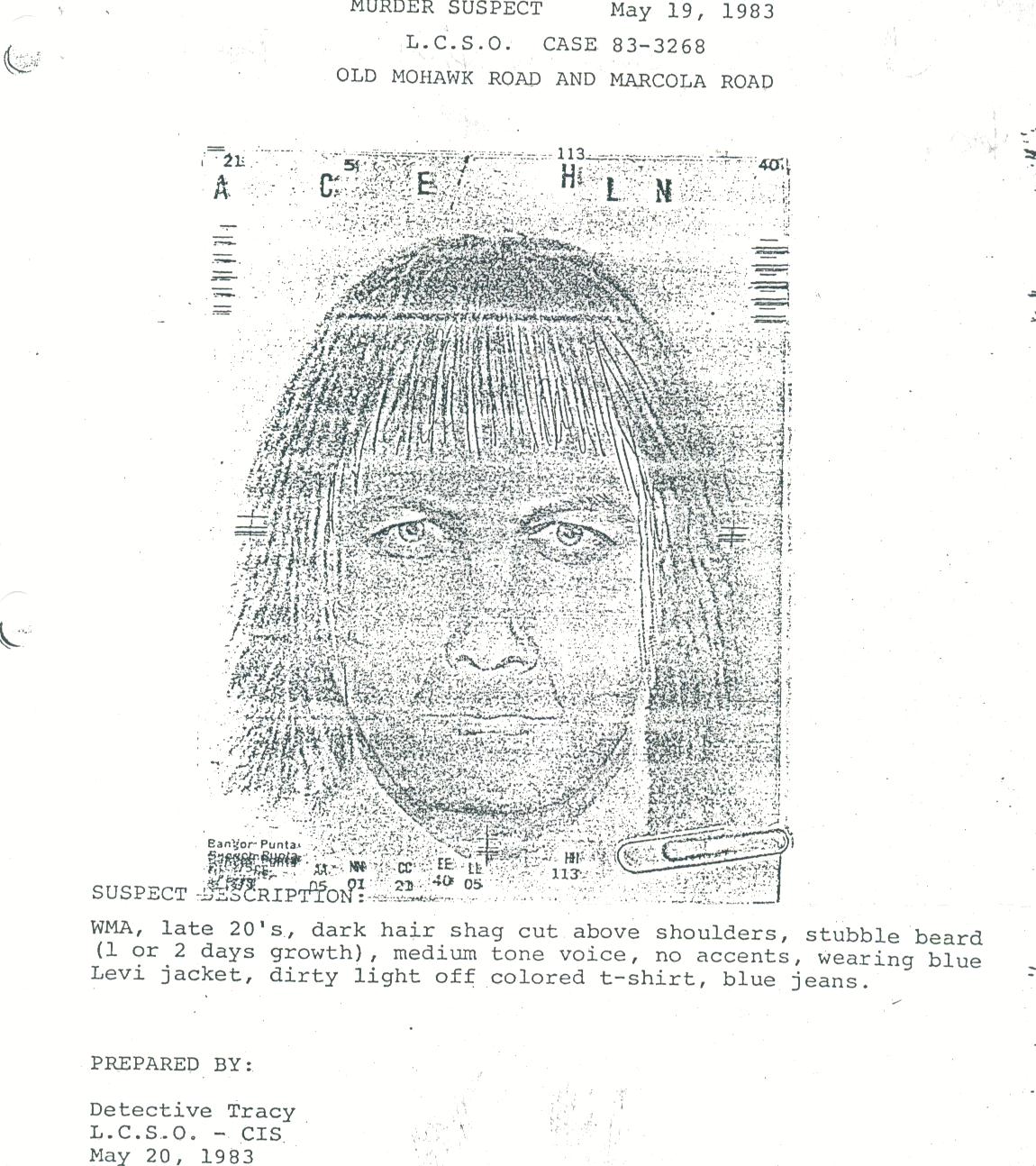
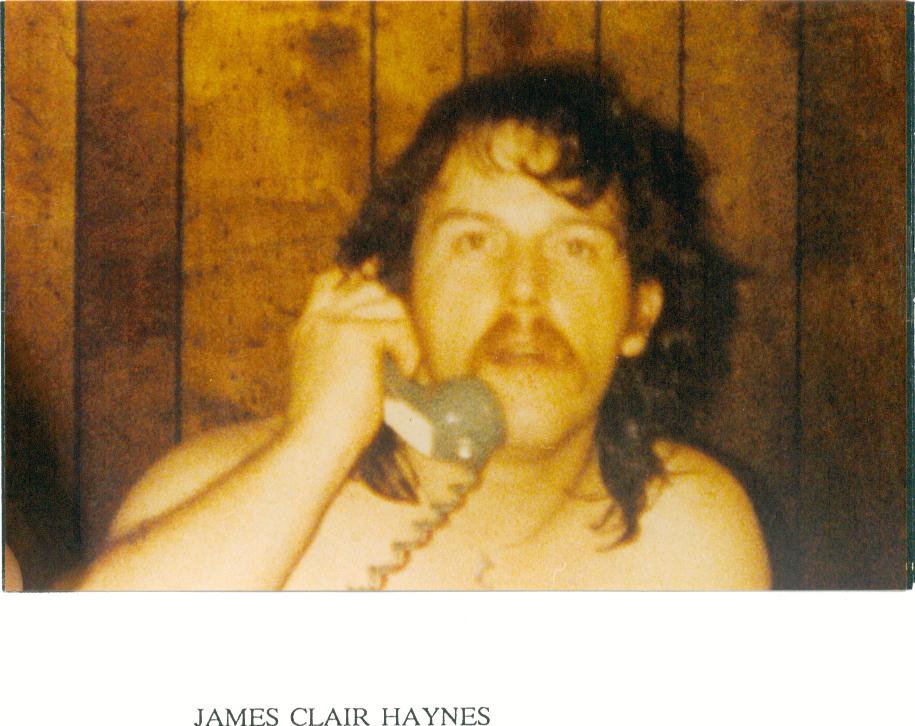
Look at the eyes, the nose and the shag haircut.  Do you see the cheekbones?  The similarities are there for you to see. Why would Jim Haynes confess to Teresa Nyjordet that he was the one who shot Diane Downs and her children if he didn't?  Here is a little of what she said, but Go to:   Teresa Nyjordet.pdf if you want the whole story.

 There's more:  Janet Rexroad.pdf  Here is some of what is in that affidavit:

When I asked him if he had shot the Downs family, he admitted it said it was a hired hit. I told him the picture looked just like him, and he replied, "Yea, but they'll never catch me."

Read the affidavit.

 Cecilia Nysten, Clayton Nysten's ex-wife, makes a few very interesting comments in her affidavit about both Jim Haynes and Clayton Nysten:  


Go to:  Cecilia Nysten.pdf I've seen the place Cecilia Nysten spoke about.  It's a pond on Clayton Nysten's property and I was told they disposed of weapons in that pond if they didn't want anyone to find them.  I was told they covered the weapons with cosmoline and placed them in plastic bags to prevent rust.

When I interviewed Sandy Capps in 1993, her name was Sandy Stichler.  She was baby sitting Jim Haynes' children when I met with her.  She shared a lot of very pertinent information, but was afraid to make an affidavit so I never included it in any of my writings.  When the Federal Public Defenders interviewed Sandy Stichler in 1998, her name was  Sandy Capps she agreed to sign an affidavit then changed her mind because she was afraid.  In the affidavit the Federal Public Defenders made of their conversation with Sandy Capps, she said:


To read more, go to:  Sandy Capps.pdf

  On August 28, 1993, the first person to share with me about James Haynes' confessions of guilt, was Fran Wirta.   Listen to what Fran had to say:   Fran Wirta (128Kbs).mp3   Now read what she had to say:  Fran Wirta.pdf Roxie Haynes was afraid to give an affidavit:  Roxie Ann Haynes.pdf  There's more, but by now I think you get the point.

Read Debra Frisch's comments about Judge Malcom Marsh's decision:  Judge Malcom Marsh\Document.rtf

2.  Trace Metal Tests

To shoot someone, you have to hold the gun.  Diane remarked that the police sprayed her hands with a substance on the night of the shooting.  She said she had a small cut on her hand and the spray burned a little bit.  She said they sprayed her hands until the substance dripped onto the floor.  This is called a Trace Metal Test and the purpose is to determine whether or not you have held a gun. The Trace Metal Tests came back negative Diane did not hold the murder weapon.  She did not shoot her children.

 Police Officer Robert J. Antoine under direct examination said: "I didn't find any discoloration."  See:  Trace Metal Test.pdf

3.  Gun shot residue and Blood Spatter

According to the prosecution the gun was held from 0 to 8 inches from each child when the shots were fired.  The upper torso of the shooter would be covered with blood spatter and gunshot residue.  Diane was not.   You might wash your hands, but you can't wash it out of your hair and off your clothes.  The Antimony and Barium report came back: 

 See:  Antimony and Barium.pdf Did they check for gun shot residue or blood spatter (blow back)?  You bet they did.  According to the state the shooter was well within the car.  Not only would the shooter be covered with gunshot residue in the hair and on the face, but it would be all over her clothes.  Don't forget the blood spatter.  The shooter would also be covered with blood spatter from the blow back, in the hair and on the clothes.  Diane Downs did not have blood spatter or gun shot residue on her, but the shooter did.  Diane did not shoot her children!!

4.  Christie Downs not a witness #1 

Okay, so Diane passed the trace metal test, she had no gunshot residue or blood spatter and now there's a man who is confessing to his friends and family that he is the shooter of the Downs family.  What about the testimony of Diane's daughter, Christie?  Christie testified in court, "My mother shot Cheryl, then Danny, then me."   Under cross examination, Christie said that Cheryl was sitting on the front seat when she was shot: Christie's Testimony 672 lines 11-18.pdf  Diane said Cheryl was lying on the front floorboard with the passenger seat pushed back.  Cheryl was shot twice in the back with one of the bullets passing through her body and ending up on the floor board:

Cheryl could not have been shot twice in the back while she was sitting up and have the bullet pass through her body and end up under the floorboard of the front passenger side of the vehicle.  Cheryl was asleep on the front floorboard like her mother said.  Christie was not a witness.  The State taught 8 year old Christie what to say.  Christie was asleep like her mother said.

5. Blood Spatter

When a bullet strikes a body, blood sprays back in the direction the bullet came from.  This spray is called blowback.  Read what Criminalist James Pex says on page 1247 under cross examination:

1 interference, assume we have the ideal of being able

2 to shoot and no interference and assuming it's a

3 straight shot, do you expect some kind of uniformity

4 in the response, in the back spatter or do you not?

5 A. You can't really reasonably answer that

6 question because to create a back spatter situation I

7 have to make a near contact or contact shot, and

8 you've got to have something there to do that.

9 So it's not possible to create a back

10 spatter pattern like this and get a perfect pattern.

11 Q. The next question would be this, assuming

12 that you have a body upright and the weapon being

13 completely perpendicular to it, do you expect then the

14 back spatter to occur back in the direction of the

15 weapon?

16 A. Yes

17 Q. Assuming that the body then comes to more of

18 an angle say of 45 degrees to the firing of the

19 weapon, where do you expect the back spatter in that

20 kind of situation?

21 A. It depends on the angle of the entrance

22 hole, but you have to keep in mind that the blood

23 comes right back out the hole.

24 Q. I want to explore this enough so we have

25 sufficient understanding so we can apply it to some of

To read Mr. Pex's  actual testimony go to: James Pex 1247 .pdf

According to the state, the shooter kneeled down on the front seat and shot Christie twice beside the left nipple.  If you consider what James Pex has to say, with Christie sitting up, there should have been blood spatter on the back of the front seat or seats, but there was not.

In direct questioning, Mr. Pex was asked a question:  "The next question would be this, assuming that you have a body upright and the weapon being completely perpendicular to it, do you expect then the back spatter to occur back in the direction of the weapon?"  Mr. Pex's answer was:"Yes."

The absence of blood spatter on the backs of the front seats are proof that Christie wasn't sitting up when she was shot.

Christie was coached by many people to get her to say she saw her mother shoot her.  She was just 9 years old, had been taken away from her mother and her grandparents and she was literally hammered with leading questions to get her to say what they what they wanted her to say.  I have placed photographs of Christie which show entry wounds and exit wounds to show why she could not have been a witness.  Christie was shot twice beside the left nipple. 


One bullet exited at the base of the neck and the other lodged medial to it under the left scapula and was removed later during surgery.

.

Consider the direction the bullet would travel with Christie sitting up and the shooter kneeling on the front seat and  leaning over to fire two shots.  Remember, Christie was only 48 inches tall and Diane is 5 feet 5 inches tall.   The height from ground level to the back seating area of a 1983 Nissan Pulsar, a two door vehicle, is approximately eighteen and one half inches.  Why don't you try it?  Put a 48 inch tall person on the back seat of your car and have a 5 foot 5 inch person kneel on the front seat and point at the left breast area, just below and slightly to the left of the left nipple.   You can try this same experiment using dining room chairs (they are approximately 17 to 18 inches tall).  The seat backs of the car from the seat level to the top are approximately 19 to 20 inches high. Which way does the bullet go?   Downward!!  Christie was not sitting up. Look at the two photos again, the trajectory was upward. Christie was not a witness, yet they taught her to believe she had witnessed the shooting.

There's no blood spatter on the back of the front seats, so where is the blood spatter?  Look at the ceiling of the vehicle:

 The blood spatter is on the ceiling of the vehicle, that's more evidence Christie was lying down.  Why is there no blood spatter on the backs of the two front seats?  The answer is:  Christie wasn't sitting up like they taught her to say.  The blood spatter was upward, which could not be if Christie was sitting up.  Christie was lying down when she was shot.  Christie was not a witness.  Shame on you Doctor Peterson for teaching a little girl to believe false information.  See:  BLOOD SPATTER

6.  Christie Downs not a witness #2

 Friends from Kennedy Elementary School said Christie showed them a picture she drew of the "man" who shot them.  Dena Reinhardt of Las Vegas, Nevada called Christie when she was in high school.  Dena recorded the conversation and Christie admitted to her that she didn't know who shot her, but said in court what they wanted her to say.  Sally Chambers of Banks, Oregon put that tape into writing in booklet form.  A copy of that booklet was sent to Diane's new attorney in Salem, Oregon.  On page 32 of that translated conversation, Dena Reinhardt continues her very long conversation with Christie "...Or do you think she really, you think she really didn't do it, huh?  Christie's answer:  "I couldn't tell you, I mean I don't know who did it." Go to: CHRISTIE DOWNS

7.  Psychologist, Dr. Carl Peterson.

Let's examine this a little further.  Was Christie a witness?  Psychologist, Dr. Carl Peterson was retained by the State to help Christie rebuild her memory. I have reason to believe his professional stance may have been compromised.  He wrote a letter to Susan Staffel of Children's Services in which he said:


Shame on you Doctor Peterson for not disqualifying yourself and your prejudice.  

In that same letter, Dr Peterson writes:

In the course of those contacts I have helped Christy to access some of the feelings she associates with her sister's death. Throughout the duration of that work I have continued to be struck by the strength of Christy's resistance or blockage to accessing feelings she undoubtedly associates with the perpetrator of this crime. You can read that letter with both of these comments at:  Dr. Peterson letter 3.pdf  Whose feelings was Dr. Peterson accessing?  Was he objective?  If you want my opinion, he was accessing his own feelings, giving them to Christie, and he wasn't objective.  This should have sent out a message to the authorities that Dr. Peterson could not be objective. On the other hand, it seems apparent the District Attorney wanted to win this case regardless of who got hurt.  It  should have made it clear that Doctor Peterson would help her remember that her mother shot her even if she didn't.  Christie had no contact with her family except for Danny.  Was Dr. Peterson objective?  Let's take a look at notes from the session of December 19, 1983 and see.  The notes are typed from copies of Psychologist Carl V. Peterson's handwritten notes.  Some words were unclear, but the intent was obvious.  The lines with an asterisk are Dr. Peterson's comments.  I'll highlight those in yellow for you:

12-19-83    sess    Christie Downs

I want my mom to tell the truth first  m.b. (maybe) I'll get to see her again  -- Mr. Furtick

Page Elem  (Page Elementary School)

out door w Cheryl

g'parents  (went to grandparents house)

eat snack —

watch TV

had dinner

mom ate dinner

kids & mom got in car & went to mom's house

played & then got in car & drove out to

Heather ( Mrs. Purdin) (Heather Plourd's house)

at. (at time) of incident

    ---guns in trunk, big & little

    never saw anybody else  - voice stammer

    didn't see anybody go back to trunk

    even if my mom shot me, Cheryl & Danny, I'd want to go back w (with) her cause it wouldn't happen again.

m.b. (maybe) she just got really, really, really angry & it wouldn't happen again. Dr. Peterson offers a suggestion that Christie's mom got really, really, really angry.

talk about Xmas sing at school Now Dr. Peterson changes the subject and talks about a Christmas sing at school and then he comes back with a follow-up to his previous statement:.

*  do you think she'll get really, really, really angry again?  shrugs shoulders Christie has been talking about a Christmas sing at school and is suddenly hit with a question and is wondering where the Christmas sing went to so she shrugs her shoulders.

*  but you don't think that she'd shoot at you?  ---"anymore" This one is the clincher, "anymore."  Dr. Peterson has forgotten what objectivity really is. 

  Doesn't it make you feel really, really really proud to know what good hands the State of Oregon placed Christie in?  Everyone who came in contact with Christie  was helping her remember, even when they didn't know what her memory should have been.  With a child it's easy enough to to help them remember, even if that memory doesn't exist.  See: DOCTOR CARL PETERSON

8.  Doctor Ira Hyman 

Dr. Ira Hyman offers his clinical evaluation of what could have happened in Christie's memory enhancement.   On page one, following Dr. Hyman's letter of introduction, he says:


 See Dr. Hyman's complete evaluation: Dr. Hyman.pdf

9.  Danny Downs

Danny had been hospitalized at the McKenzie Willamette Hospital in Springfield and was moved to Sacred heart in Eugene.  On June 20, 1983. Diane went to visit Danny at Sacred Heart and was told she could not visit Danny.  According to J. Jones, Diane was "very angry, hostile about being restricted on visitation."  Let me ask you a question.  If someone said you couldn't visit with your baby in the hospital, do you think you might become a little hostile?  On July 13, 1983, Danny told the nurse a man shot him.  He went from being coached to say "mommie"  to "That man shot me."

The above message is from a page of hospital records.  "Do you know who shot you?... That man,"  he replied.

10.  Ballistics

Was John Murdock, Director of Contra Costa County Laboratory a "Liar" or did he just make an "error" when he gave his testimony in court?  When he testified in court, "Exhibit 14 does contain two cartridges with plain lead bullets, and I did examine those,...."  This was not the truth.  If it isn't the truth, it's a lie.  John Murdock was no novice.  He knew a cartridge from a casing.  Two lead cartridges were allegedly taken from Diane's apartment and it was said they matched those from the shooting site.  One of those bullets was taken apart to compare gunpowder with the gunpowder from the shooting site.   The gunpowder didn't match.  Neither the cartridge nor the casing  matched those from the shooting site either. 

Go to:  Murdock Testimony page 1347.PDF 

And also:  Murdock Testimony page 1348.PDF 


John Murdock says: 

The problem is: There could not have been two cartridges in that box.  Read a little further, you will find that one of those cartridges (14 A) had been taken apart to get gun powder.  Guess what!  The gun powder didn't match.  They wouldn't let something as vital as that get by them.

Take a look:


On June 27, 1983, a month after the shootings, John Murdock, Director of the Contra Costa County Laboratory in the Sheriff's Department in Martinez, California began his comparison of the ballistic evidence. He started by evaluating each piece of evidence, bullet, casing, or cartridge.  (The bullet is the projectile, the casing is the empty cartridge, and the cartridge is the bullet and casing totally intact with the gunpowder inside.)   Mr. Murdock would then establish the validity of each piece.  This, according to his notes, involved noting the degree or depths of each tool mark in regard to actually being able to make literal comparisons with other such evidence.  He lists each identifying number, such as E3, E4A, etc., with the corresponding tool marks as, one extractor mark at 3 o'clock and the ejector mark at  7-8 o'clock.  All casings from the shooting site (the road and the car) were exactly the same, extractor mark 3 o'clock, ejector mark 7-8 o'clock. 

The cartridges allegedly taken from Diane's rifle are listed in a glaringly different manner.  E14A is noted to have one extractor mark and no clear ejector mark and E14B is listed as well defined extractor mark and one fairly well defined ejector mark, "close to the extractor mark," The description changes. .  It's not 3 o'clock and 7-8 o'clock, but now it's "close to extractor."   It's double talk.  They don't match!!!

 I called John Murdock at his home in California to point out the above discrepancies.  The first thing he wanted to know was how I found him.  When I mentioned the discrepancies, he told me he would no longer talk to me without his attorney present.  That sent a red flag up, waving wildlyWe have a big problem here.  Why would John Murdock need an attorney present if he had told the truth?  To get an education in ballistics,  go to: BALLISTICS

11.  The murder weapon.

Diane moved from Arizona to Oregon in early April 1983 and the shooting was on May 19, 1983.  The State said Diane used Steve Downs' gun to shoot her children.  Diane said the gun was in Arizona with her ex-husband.  She said she didn't have the gun, so I ran an ad in the Arizona Republic newspaper for a week in 1984, offering a reward for Ruger #14-76187.  This ad resulted in a letter from Prescott, Arizona from a man saying he had the gun:  Gun Response.pdf  It was learned later that the man who sent the letter worked as a security guard at Fort Whipple, just outside of Prescott.  The Sheriff's Office in Oregon eventually gave a press release that the report was a hoax.  The newspaper article said that Detective Diffendaffer of the Prescott, Arizona police department had conducted the investigation. 

A few years later I contacted Detective Diffendaffer to discuss his investigation.  According to Detective Diffendaffer,  Detective Dick Tracy, from Oregon conducted the investigation alone.  He did not go with Detective Tracy on the investigation.  A few months later the gun was found in a drug raid in Perris, California.  This is the area where Detective Tracy had been employed before moving to Oregon.  Lane County, Oregon recovered the weapon and ran tests to determine if it was the gun used in the shooting.  The ballistics from the shooting site didn't match Ruger #14-76187.  The gun Diane had been convicted of using to shoot her children was not the murder weapon.   The State's theory that Diane had used that pistol in the shooting of her children was in jeopardy, so the State then decided she must have used another gun.

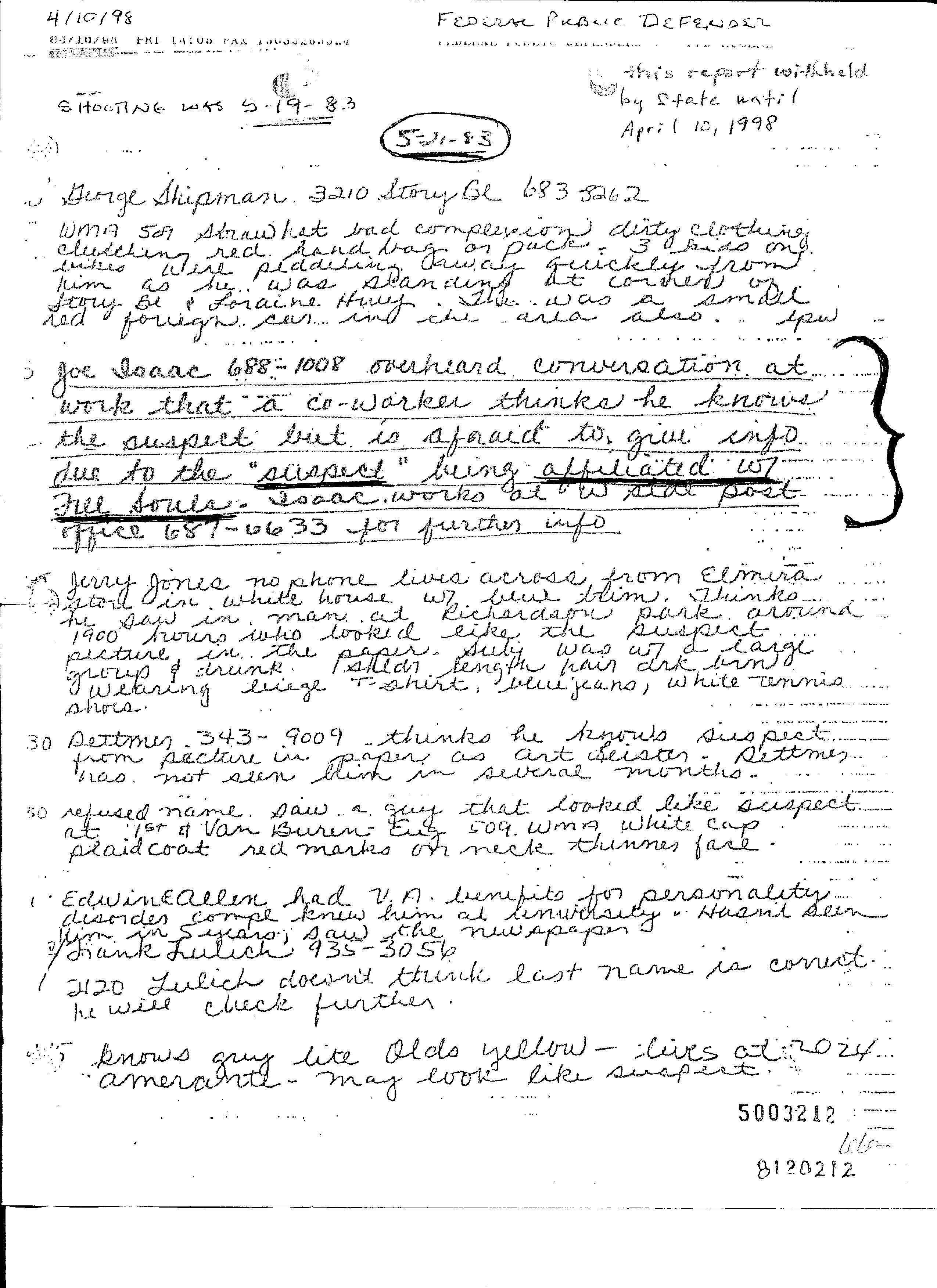
12.  Did they follow leads?

  The Sheriff's Office said they were following leads when they weren't.  In court, they told the attorney for the defense there were no more leads.  Roy Pond testified there were only 30 to 35 leads.  Judge Gregory Foote said he had a problem with that detective's testimony.  In 1998, the Federal Public Defenders requested all the records that were held regarding  this investigation and any possible leads that might still be available.  They were told by Detective Doug Welch the records had been destroyed.  The Federal Public Defenders pursued this issue even further and found, according to William Teesdale of the Federal Public Defenders Office:   "On March 4, 1998, Ms. Willis and I returned to the Lane County Sheriff's Office and spent a full day copying the material from the three boxes, amounting to about 4700 pages of documents..."   Teesdale affidavit.pdf

13.  Deviant Sociopath?

  When Diane was being questioned by Fred Hugi in court, he alluded that Diane had been labeled as a "deviant sociopath" by Doctor Polly Jamison.  Doctor Polly Jamison sent Defense Attorney James Jagger, Prosecuting Attorney Fred Hugi and Judge Gregory Foote a note:


 James Jagger, Defense Attorney, Fred Hugi, the prosecuting attorney and Judge Gregory Foote refused to correct the statements made before the jury.   In an affidavit prepared for the Federal Public Defenders on September 12, 1997, Doctor Jamison has this to say:


 In Doctor Jamison's affidavit she said, "I never diagnosed Ms. Downs as "deviant sociopath,"...   Go to:  Dr. Jamison affidavit.pdf

Go to:   DEVIANT SOCIOPATH      ANTIMONY AND BARIUM       BALLISTICS    BLOOD SPATTER  MURDER WEAPON